OpenAI has officially launched ChatGPT Work, an autonomous AI agent embedded directly inside its flagship chatbot.
Powered by GPT-5.6, this new iteration leverages Model Context Protocol (MCP) plugins to natively connect with email, Slack, calendars, and GitHub. Rather than just answering prompts, the agent is designed to execute multi-step corporate workflows independently from coordinating meetings to generating finished financial reports and interactive websites.
The launch marks a critical commercial milestone for OpenAI as it prepares for a historic IPO:
- Market Valuation: Anticipated between $730 billion and $852 billion.
- Revenue Shifts: Annualized revenue has blown past $25 billion, with enterprise adoption now accounting for more than 40% of total revenue.
- Competitive Landscape: The rollout positions OpenAI directly against Anthropic’s Claude Cowork and Microsoft’s Copilot Cowork for dominance over the enterprise desktop.
A Story of Distribution, Not Adoption
For leadership teams across the Banking, Financial Services, and Insurance (BFSI) sectors, this launch matters less as a technology feature story and more as a distribution story.
ChatGPT already boasts over 9 million paying business users. This means the agentic layer isn’t a new piece of infrastructure that enterprises have to evaluate, clear, and adopt from scratch; it is simply being switched on inside environments where employees already work.
In collections and credit operations, this shifts the strategic question overnight:
It is no longer a question of “will enterprises adopt agentic AI,” but rather, “which workflows will they let a general-purpose agent touch first?”
An assistant that is permitted to read internal Slack channels and draft documents is only one API integration away from touching highly sensitive account data, payment reminders, or dispute correspondence.
Horizontal Capability vs. Vertical Readiness
What early media coverage understates is the deep chasm between horizontal utility and vertical compliance.
ChatGPT Work is engineered to generalize. It schedules engineering “bug bashes,” drafts outward-facing websites, and analyzes customer churn using the exact same underlying model class. That cross-functional breadth is its primary selling point but it is also its fundamental limitation within a regulated financial framework.
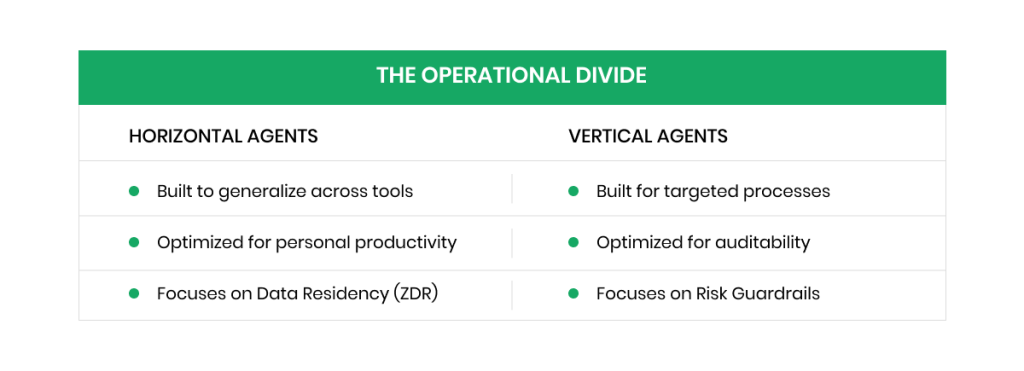
A persistent cloud agent that pulls disparate contexts to “assemble” an outcome is exceptional for low-exposure internal tasks. However, it presents a completely different risk profile when tasked with initiating an outbound collections communication or updating a core ledger.
In a money-moving environment, a plausible-sounding output that accidentally skips a mandatory compliance check or misinterprets an escalation threshold is not a temporary productivity loss, it is a regulatory incident.
OpenAI’s primary privacy defense noting that enterprise accounts feature Zero Data Retention (ZDR) answers a data-residency query, not an operational-reliability query.
The Path Forward for Financial Operations
Production deployments in high-stakes environments prove that horizontal workplace platforms and vertical operational agents solve entirely different problems.
Operationalizing an AI agent inside collections requires domain-specific guardrails, deterministic escalation paths, and workflow logic built specifically around what a sensitive customer conversation demands. It cannot rely on a generalized connector to an inbox or a calendar.
As distribution-scale players push agentic AI deeper into everyday corporate tools, the ultimate differentiator for regulated sectors will not be which assistant is most widely installed. It will be which agent was built from the ground up to operate safely within the strict, unyielding constraints that financial workflows demand.