A major June 2026 VentureBeat Research survey of 573 technical enterprise leaders across the agentic tech stack has delivered a striking reality check: governance is lagging behind deployment everywhere it looks.
As organizations rush to capture the economic promise of AI automation, the infrastructure underneath them is running ahead of the controls needed to secure it.
The Core Tech Mismatches:
- Idle Infrastructure: 86% of enterprises that run their own GPUs report hardware utilization of 50% or less.
- The Trust Gap: 66% already allow or are actively building toward zero-human-review production deployments, yet only 5% fully trust the automated evaluations behind those release decisions.
- The Capability Reality: 71% of technical leaders admit that a quarter or fewer of their deployed “agents” can actually complete multi-step work unsupervised—the vast majority are simply single-prompt chatbots.
Why the Credential-Sharing and Context Findings Matter for BFSI
For BFSI and collections operations, the most alarming data points from the VentureBeat report aren’t the macro infrastructure metrics—they are the risks lurking within the security and context layers.
1. The Cascading Threat of Shared Identity
The survey revealed that 69% of enterprises permit credential sharing somewhere across their agent fleet at runtime (multiple agents operating under a single API key or service account).
The consequences are immediate:
Organizations allowing credential sharing hit security incidents or near-misses at nearly 1.6 times the rate of firms utilizing scoped identities (63.5% vs. 40.9%).
Collections workflows routinely chain several automated steps together: identity verification, account lookup, communication drafting, and payment processing. If these steps run under a single shared credential rather than tightly scoped, per-agent identities, a solitary compromise exposes the entire transactional chain.
2. Confidently Wrong Financial Disclosures
Separately, 57% of enterprises traced at least one confident, wrong agent answer directly back to missing, stale, or inconsistent internal business context—such as wrong metrics or absent documentation.
In a collections environment, this context gap translates directly to compliance failures. It means an agent could confidently misstate an outstanding balance, a settlement term, or a mandatory regulatory disclosure—not because the core LLM failed, but because the foundational business data underneath it was contradictory.
Exposing the “Agentwashing” Hype
What the broader industry conversation tends to skip is the 71% figure. Most deployed “agents” are single-prompt chatbots wearing a modern agent marketing label, not systems capable of genuine multi-step execution.
This gap between marketed adoption (which ranges from 72% to 97% in other industry surveys) and actual operational autonomy creates a dual risk for financial organizations:
- Teams may over-budget for agent-grade governance around basic, static tools that don’t yet need it.
- Conversely, operations may assume a tool carries low, chatbot-level risks when it has quietly been granted multi-step system autonomy.
Furthermore, enterprise anxiety shifted sharply from security limits toward vendor lock-in this past quarter following regulatory actions that took major models offline. Portability has officially evolved into a critical governance requirement, not just a cost-optimization tactic.
Sequencing Governance for Regulated Autonomy
The tactical fix for collections operations is not to slow down deployment, but to sequence operational governance correctly.
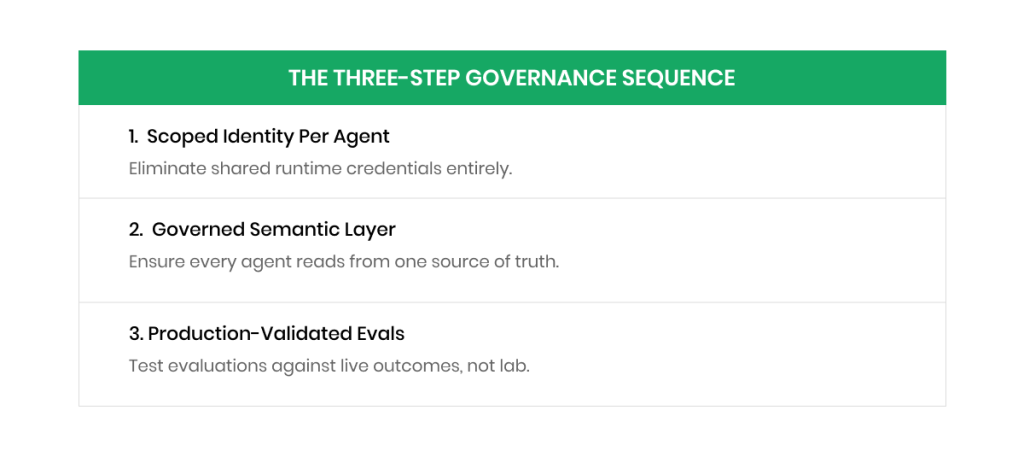
Currently, only 25% of enterprise companies run a governed semantic layer in production. In the financial sector, where a wrong answer carries immediate regulatory exposure, establishing this exact ordering is the foundational difference between automation that scales safely and autonomy that simply accelerates the failure rate alongside it.