A major Gartner survey of 321 customer service and support leaders, conducted in October 2025, has delivered a striking reality check for corporate leadership: 91% of service and support leaders are facing intense executive pressure to implement AI in 2026.
While the baseline urgency to automate is clear, the downstream impact on frontline personnel reveals a much deeper transformation.
The Changing Frontline Metrics:
- 80% of organizations plan to transition at least some human agents into entirely new roles as routine work gets automated.
- 84% of leaders plan to adjust hiring profiles and add completely new technical skills to the agent role.
- 58% intend to upskill existing agents into specialized knowledge management roles to continually maintain the content feeding their AI engines.
Moving Past the Hype: Redesigning the Role
The more consequential number here is not the 91% pressure figure, which most customer experience leaders already feel. The true operational signal is what organizations plan to do with their people once AI absorbs routine volume.
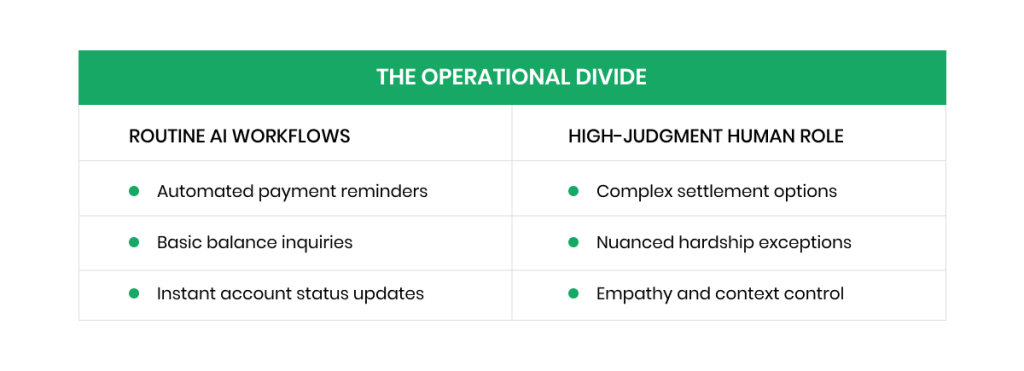
Gartner’s research framing is explicit: this is not a headcount reduction story. It is a role redesign story where human agents shift toward complex case handling and judgment calls that software cannot make.
For collections and financial services operations, this is an essential blueprint because credit workflows already split cleanly along these technical lines.
The 58% Hidden Dependency: Knowledge Infrastructure
The metric worth analyzing closest is the 58% figure dedicated to knowledge management upskilling. This data point exposes a critical bottleneck that most technology rollouts completely underestimate.
An AI system handling automated collections conversations is only as good as the internal account data, policy definitions, and compliance escalation rules it draws from.
- The Risk: If the underlying corporate knowledge base is inconsistent or out of date, the AI will produce confident, incorrect answers regardless of model performance.
- The Exposure: In a financial environment, this failure mode translates directly into serious regulatory and compliance incidents.
Gartner is effectively warning leaders that the AI application and the knowledge infrastructure behind it must be engineered in tandem, not sequentially. The people best positioned to continuously maintain that infrastructure are the veteran agents who already understand the actual cases.
Action Plan for Collections Leaders
For financial executives reading the 91% pressure figure and feeling that exact same operational urgency, the practical takeaway is to resist treating AI adoption as a simple headcount replacement conversation.
The 80% of organizations reshaping frontline roles are making a calculated bet that a blended model outperforms either full automation or the status quo. That strategic bet only pays off if the operational shift is executed deliberately:
- Map Tasks Precisely: Identify which specific credit operations belong entirely to conversational AI and which require human empathy.
- Invest in the Knowledge Layer: Build a structured, human-verified data framework to keep the automation accurate as volume scales.
- Reskill the Frontline: Establish clear transition paths for top-performing agents to evolve into system managers and managers of context.
The financial institutions that protect their margins under regulatory scrutiny will not be the ones that rushed to remove people from the process. They will be the ones that used AI to make the administrative drift disappear so that their human agents can focus entirely on high value exceptions.