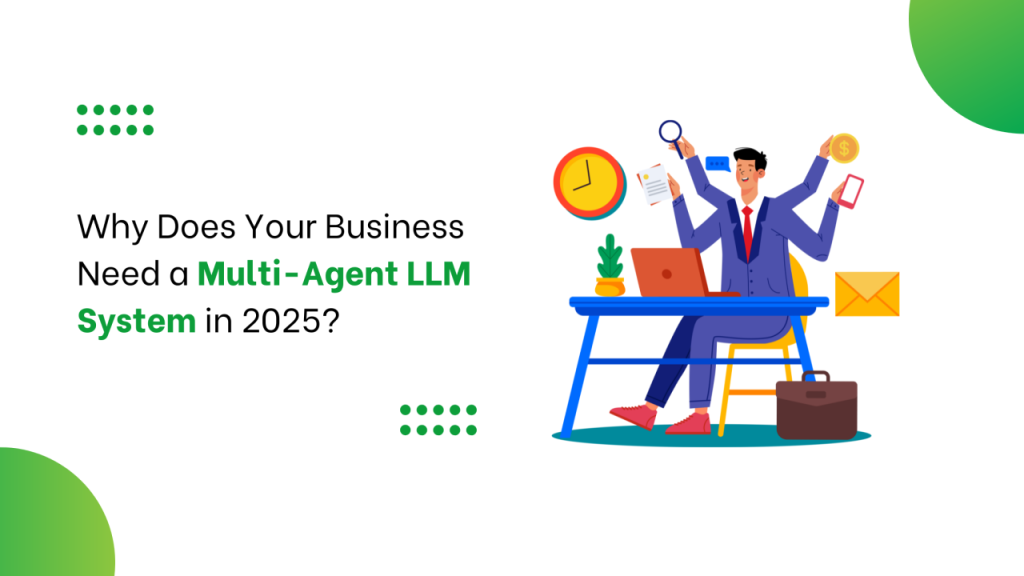
In 2025, enterprises face an overwhelming challenge i.e, maintaining agility and precision while managing increasing customer demands.
Traditional AI Agents, while helpful, often fall short in delivering the seamless collaboration and adaptability modern businesses require. But Multi-Agent LLM Systems offer a different approach to solving these challenges. By combining the strengths of multiple specialized AI agents, these systems promise to transform business operations in 2025 and beyond.
And in today’s blog, we’ll not only explore what Multi-Agent LLM Systems are but also how they work, their architecture, and why businesses should prioritize them in 2025.
But What Exactly Are Multi-Agent LLM Systems?
To understand multi-agent LLM systems, it helps to first consider the limitations of single-agent AI setups. Traditional AI systems often depend on one central model to manage a variety of tasks. While these systems are versatile, they can lack the depth required to excel in specialized areas.
Multi-agent LLM systems take a different approach. Rather than relying on a single, general-purpose model, they employ multiple specialized agents, each designed to excel in specific tasks like, customer support, compliance, or data analytics. These agents work collaboratively, using a shared language model as their communication backbone. Think of it as a team of experts, each bringing their unique strengths to solve complex problems more efficiently. This collaborative design transforms AI from a one-size-fits-all tool into a dynamic, multi-functional system tailored to enterprise needs.
Single AI Agent vs Multi-Agent LLM Systems
Single AI agents are designed to handle specific, linear tasks, such as answering FAQs or processing basic requests. While they perform well within their scope, they lack flexibility and struggle with complex, multi-layered interactions.
In contrast, Multi-Agent LLM Systems act as a synchronized team. Key differences include:
- Specialization: Multi-agent systems distribute tasks among agents with unique capabilities, whereas single agents offer generalized support.
- Scalability: Multi-agent systems excel in handling large-scale, diverse tasks simultaneously.
- Adaptability: Multi-agent systems collaborate to refine decisions, offering greater adaptability and accuracy in dynamic scenarios.
So for enterprises, these differences mean faster responses, better context handling, and superior problem-solving all the way through.
How Do Multi-Agent LLM Systems Work
To put it simply, multi-agent LLM systems consist of specialized AI agents working collaboratively to handle complex workflows. Each agent is designed for specific tasks and integrates seamlessly with a shared core language model. Here’s how they function:
1. Specialized Agents for Core Functions:
Each agent acts as an interface for a specific function or data source. For instance, a customer service agent connects with a CRM system to fetch data and provide precise responses, simplifying user interaction with otherwise complex systems.
2. Context Tracking via Intent Logs:
An “Intent Log” then records user requests and agent actions, offering transparency and context. This ensures every decision or recommendation is auditable, building trust in the system.
3. Safeguard Agents for Compliance:
After that, to ensure safety, safeguard agents monitor actions for regulatory compliance. If a process risks breaching policies, like GDPR, these agents intervene, either halting the task or escalating it to human supervisors.
4. Collaboration Between Agents:
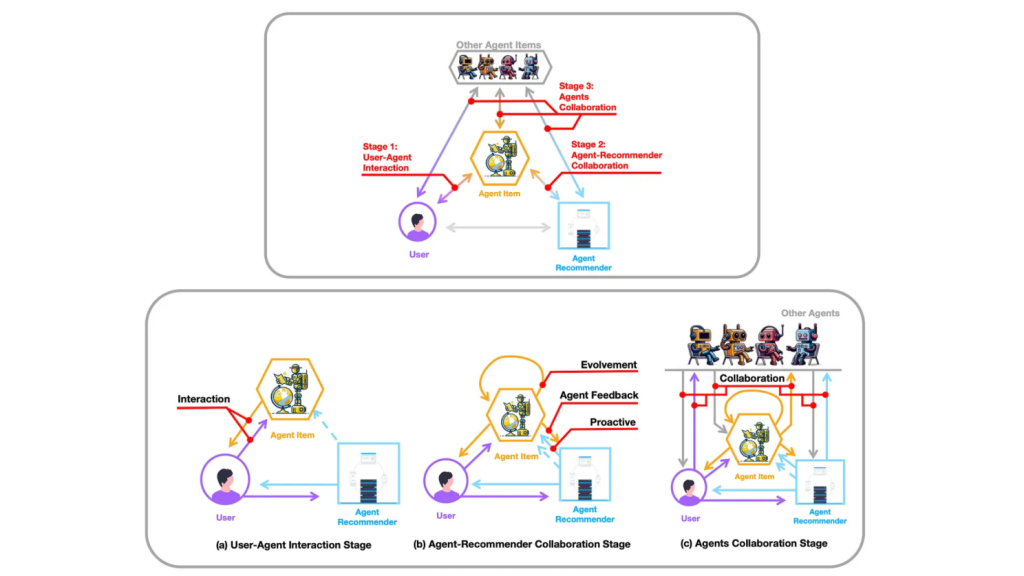
Agents communicate and share insights simultaneously for well-rounded decisions. For example, a procurement agent might collaborate with a supply chain analytics agent to combine supplier data with trend analysis, ensuring informed decision-making.
5. Adapting to Evolving Needs:
These systems adapt seamlessly to enterprise changes. Introducing a new function becomes effortless, as agents collaborate dynamically or new agents are added without disrupting workflows.
This ability to ensure compliance, track interactions, and adapt while fostering agent collaboration makes multi-agent LLM systems a transformational solution for enterprises.
And now that we have understood its working, let’s briefly understand how its architecture enables it to coordinate with such ease.
Architecture of Multi-Agent LLM Systems
The architecture of multi-agent LLM systems enables specialized agents to work independently and collaboratively, handling complex workflows efficiently. Here’s a breakdown of its key components:
1. Core Language Model:
The foundation is a large-scale language model that provides a shared understanding of language, ensuring seamless communication between agents while supporting their specialized tasks.
2. Agent Specialization Modules:
Agents are fine-tuned for specific roles, such as customer support or HR compliance, using task-specific data. These modules ensure each agent excels in its domain, like resolving customer issues or managing employee records.
3. Communication Layer:
This layer facilitates real-time information exchange and task coordination. For instance, a support agent can flag issues to a data analytics agent, which processes trends for actionable insights.
4. Coordination Engine:
It manages task priorities, resource allocation, and conflict resolution, ensuring efficient workflows. During a supply chain issue, the engine can prioritize procurement tasks and redirect resources accordingly.
5. Knowledge Base and Memory:
A shared memory system allows agents to store and access information collaboratively. Insights processed by one agent become instantly available to others for better decision-making.
6. Integration Layer:
These interfaces connect agents to enterprise systems like CRMs and ERPs, ensuring real-time data access for accurate actions.
7. Security and Compliance Layer:
This last layer enforces data protection and regulatory compliance, monitoring agent activities and preventing unauthorized actions.
This comprehensive, robust architecture ensures multi-agent LLM systems deliver efficiency, collaboration, and security in enterprise workflows.
Why Businesses Should Adopt Multi-Agent LLM Systems in 2025?
Though traditional AI Agents might just work for businesses during simple linear tasks, here is why enterprises can’t afford to ignore Multi-Agent LLM Systems:
- Enhanced Accuracy & Reliability: Specialized agents reduce errors, ensuring reliable and precise results.
- Dynamic Business Communication: Fosters more natural, engaging conversations with customers, partners, and employees.
- Improved Problem-Solving: Collaborating agents analyze and resolve complex issues faster.
- Streamlined Operations: Automate repetitive tasks, allowing teams to focus on strategic goals.
- Improved Handling of Extended Contexts: Maintain continuity in long interactions, offering a seamless user experience.
- Risk Management & Forecasting: Predict and mitigate potential risks with advanced analytics and forecasting capabilities.
Summing Up:
Multi-agent LLM systems transform how businesses approach AI, offering unparalleled accuracy, efficiency, and adaptability. However, its implementation requires a strategic approach, considering granularity, LLM types, and fine-tuning factors.
At Ori, we specialize in building enterprise-grade, autonomous, omni-channel Gen- AI agents that connect with your customers in their preferred language while driving your business goals. Book a demo with our experts to learn how we can help you do the same for 2025 and beyond.